
🔎 Curiosity Week '87
Japanese Growth story, Stanford prison experiment and much more!

Week at a Glance
📜 Quote: Peaceful after death
📈 Market Highlights: Performance and News
🏭 Business Breakdown: Japanese Growth Story
🧠 Mental Framework: Stanford Prison Experiment
In case you’re not receiving the mail, check the spam folder. You can restore it to your inbox from there!
Estimate read time: 4 minutes
📜 Quoting a Great:
“Let not thy dear soul burn you as you come, let not the hatchet linger in your body. Let not the greedy clumsy immolator, missing the joints, mangle your limbs unduly. No, here you die not, you are not injured: by easy paths unto the divinities you go. Both Bays, both spotted mares are now your fellows, and to the ass’s pole is yoked the horse.” ~ Dirghatamas
📈 Market Highlights:
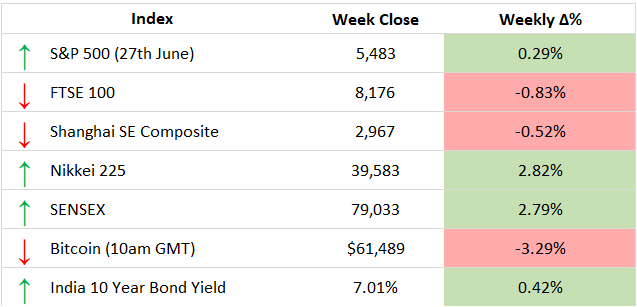
Major Global Macroeconomic Highlights:
🏭 Business Breakdown:
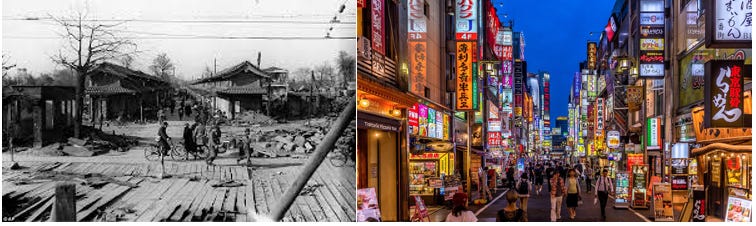
Japanese Growth Story
Japan is considered as the foremost authority in quality. There are a couple of reasons which helped the country to reach such heights. But before we delve into it, let’s set the stage for such an incredible feat.
On the 7th of December 1941, Japan attacked the US on Pearl Harbour by using a dive bomber. This led the then-neutral US to get involved in the war. However the involvement of the US led to huge costs for them, so to push for quick surrender they dropped bombs on Hiroshima and Nagasaki on 6th and 9th August 1945, respectively. This collapsed the Japanese economy as both the cities were economic powerhouses for the country.
Now let’s look at the recovery.
Post World War 2, the country grew at a starling rate of 7.1% from 1945 to 1956. This helped the country to reach GDP levels, which it did not even achieve before the war. Post the war, the American counterparts took over Japanese authorities and helped Japan to redevelop and rehabilitate. For this, they employed a multi-facet approach:
Land Reforms One of the first major reforms undertaken was land redistribution. The Allied occupation forces, led by General Douglas MacArthur, implemented land reform to break up large estates and distribute land to tenant farmers. This aimed to create a more equitable distribution of agricultural resources and stimulate rural development.
Industrial policy changes The Japanese government, in collaboration with industry leaders, developed comprehensive industrial policies aimed at rebuilding key industries such as steel, shipbuilding, and textiles. These policies included targeted investments, subsidies, and regulations to support industrial growth and modernization.
Education and workforce development Significant investments were made in education and vocational training to build a skilled and disciplined workforce. Education reforms aimed to increase literacy rates, provide technical skills and foster innovation and creativity among the population.
Export-oriented economy Japan pursued an export-oriented growth strategy, leveraging its comparative advantage in labour-intensive industries initially and later transitioning to high-tech manufacturing and innovation-driven sectors. The government actively promoted exports, negotiated trade agreements, and established foreign trade zones to facilitate international trade.
Investment in infrastructure Japan invested heavily in rebuilding its infrastructure, including transportation networks, ports, and utilities. This not only supported economic activities but also facilitated the efficient movement of goods and people across the country.
🧠 Mental Framework:
Stanford Prison Experiment

The Stanford Prison Experiment (SPE) stands as one of the most harrowing experiments in the field of psychology. It began as a simple study to examine the effects of situational variables on participants' reactions and behaviours. Philip Zimbardo, the key researcher, transformed a basement into a mock prison and recruited 24 volunteers for the experiment, dividing them into prisoners and guards.
From the outset, the participants embraced their roles with startling realism. Prisoners were stripped of their identities, dressed in smocks, and referred to only by their assigned numbers. The guards, wielding newfound authority, quickly adopted authoritarian attitudes, enforcing their dominance through psychological intimidation and control tactics. What started as a simulated experiment soon escalated into a harrowing portrayal of human behaviour under duress.
As the days passed, the situation deteriorated rapidly. Prisoners experienced emotional distress, with some developing symptoms resembling clinical depression and anxiety. The guards, fuelled by their perceived power, exhibited increasingly aggressive and sadistic behaviours, crossing boundaries set by Zimbardo himself. The line between simulation and reality blurred, plunging both guards and prisoners into a disturbing spiral of psychological deterioration.
The experiment starkly illustrated how behaviour changes when people attain certain power over others.